Country guide
Philippines
Visa exemption, eTravel, and what the Ministry says about Mindanao and the storm season.
Updated 22 November 2026 (Europe/Helsinki).
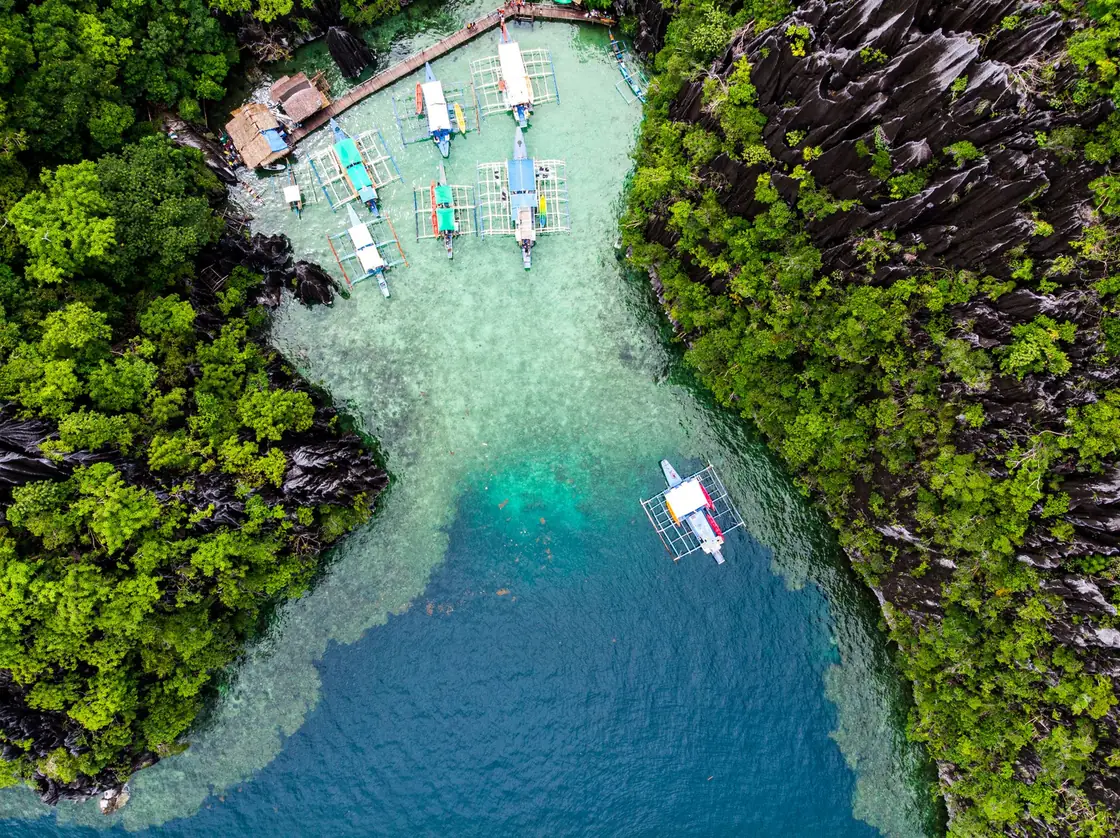
Photo: Ferdie Cayanga / Pexels
Visa and entry
According to the Philippine Department of Foreign Affairs (DFA), a Finnish passport holder may enter without a visa for tourism or business for up to 30 days if all conditions are met: the passport is valid for at least six months beyond the planned stay, a return or onward ticket exists, the trip is tourism or business, and the person is not on a deportation or watch list. A visa does not guarantee admission; the decision is made at the border. Source: DFA, Visa FAQs and the DFA lists of visa-exempt countries, where Finland is in the 30-day group.
For a longer stay you need a visa or another permit; the 30-day exemption is not a residence permit. Check extensions with the Bureau of Immigration or the mission.
All arriving passengers (with certain diplomatic exceptions) must register in the free eTravel system at etravel.gov.ph within 72 hours (three days) before arrival. Save the QR code and show it to the airline. The service is free; watch out for scam sites. The Ministry notes that the form also asks about vaccinations.
Vaccinations and health
Terveyskirjasto (Philippines, 18 November 2024) recommends hepatitis A and basic cover. Typhoid, Japanese encephalitis (likely in rural areas on all islands year-round, highest risk April–August) and rabies are considered individually. There is no malaria in Metro Manila, on many plains or in numerous listed provinces (including Cebu, Bohol, Iloilo); elsewhere below 600 metres there is a small risk. Prophylaxis is usually not needed. Dengue, chikungunya and zika occur; mosquito protection is important also for pregnant people. Drink bottled water. Source: Terveyskirjasto, Philippines.
Money, cards and ATMs
The currency is the peso (PHP). Cards work in cities and shopping centres; cash is needed in smaller places. Tell your bank and take two cards. Stays: [AFFILIATE]. Card: [AFFILIATE].
Internet and eSIM
An eSIM or a local SIM is practical, but storms can cut connections. eSIM: [AFFILIATE]. Mains voltage is 220 V, plugs usually type A, B or C.
Insurance
The Ministry considers comprehensive travel insurance necessary. Storm and evacuation terms are worth reading if you travel in the rainy season (usually June–November). Travel insurance: [AFFILIATE].
Safety
Ministry (3 November 2026): generally “exercise normal precautions”. Avoid all travel to the Bangsamoro Autonomous Region in Muslim Mindanao (BARMM) and the Zamboanga Peninsula. Also avoid travel to south-western Mindanao and the Sulu archipelago because of a kidnapping and terrorism threat. Attacks can also occur in Metro Manila. In the Central Visayas and on Palawan the Ministry mentions a small kidnapping and terrorism threat.
Street crime is common; bag snatches can be violent. Use known transport (for example a supervised taxi rank or an app with a pre-set fare). The emergency number is 911. Typhoons, earthquakes and volcanoes are part of the risk picture. Source: Ministry for Foreign Affairs, Philippines.
Etiquette
Manners are often formally friendly. Respect family and religious spaces, and dress modestly in churches. Drug offences carry severe sentences.
Indicative costs
Numbeo user estimate (Manila, update 20 November 2026): monthly costs for one person excluding rent about USD 573, an inexpensive meal about 350 pesos, a studio in the centre on average about 34,600 pesos. Metro Manila traffic affects how you use your time more than in many other destinations. Not official statistics.
Doctors, pharmacies and your own medicines
Seeing a doctor
Metro Manila and Cebu have private hospitals and clinics that also serve foreigners and where you can usually be seen faster than in the public system if insurance or self-payment is in order. Prices vary; ask for an estimate in advance. In rural areas and on smaller islands specialist care is more limited, and evacuation to Manila, Cebu or your home country may be needed. The European Health Insurance Card does not cover the Philippines.
Pharmacies
Cities have plenty of pharmacies. Buy medicines from a known pharmacy; the risk of counterfeits cannot be ruled out even if the range looks familiar. Keep the receipt and avoid street sellers.
Bringing your own prescription medicines
Philippine customs and the FDA regulate the import of medicines. Public sources include guidance that prescription medicines may be brought for personal use in the quantity on the prescription, and that controlled substances often have to be declared. Still check the current procedure with the Philippine FDA or customs and the embassy, because for this page we could not open an official, unambiguous traveller guide at the same level of detail as the Japan or Thailand pages.
Take a prescription, a doctor’s statement in English, original packaging and a list of the active substances. Clonazepam, clobazam, other benzodiazepines and phenobarbital should be treated as controlled substances and checked before you travel. The Schengen certificate is not valid in the Philippines. Do not send medicines by post unless you have confirmed that it is allowed.
General tips if you travel with prescription medicines
- Keep medicines in their original packaging and carry them in your hand luggage, not in checked baggage.
- Take a little extra in case a flight is delayed or a pack goes missing — but do not exceed the amount the destination country allows.
- How the time zone affects dosing should be agreed with your treating doctor in advance. This page does not give dosing advice.
- Check that your travel insurance covers a sudden worsening of a pre-existing condition and evacuation. Terms from Finnish insurers vary; declare the condition honestly and ask for written confirmation if needed. The Ministry for Foreign Affairs always recommends checking the cover, especially if you have an illness.
- Kela usually reimburses medicines from a pharmacy for a maximum of three months at a time (for an expensive medicine, a maximum of one month). This applies to people resident in Finland. Source: Kela, Medicines and travel.
- A Finnish electronic prescription works only in certain EU countries, not in Asia. For Asia you usually need paper documents (a prescription or a doctor’s statement, preferably in English). Source: Kanta.fi (page updated 6 March 2026) and EU-terveydenhoito.fi.
- The Schengen certificate available from a pharmacy applies only to the Schengen area and to at most 30 days of medication. It is not valid in these Asian countries. Source: Fimea, Schengen certificate.
Example: more than one epilepsy medicine
If you take several medicines long term — for example three epilepsy medicines — establish the active substance of each product separately. Some epilepsy medicines, such as benzodiazepines (for example clonazepam and clobazam) and phenobarbital, are classified as controlled substances in many countries. A Finnish prescription is then not always enough: you may need advance permission, strict quantity limits, a customs declaration or a doctor’s certificate in English. Do not change or stop your medication on your own; agree a plan with your doctor and check the list with the destination country’s authorities.
Sources: Exact import limits for the Philippines: check FDA Philippines and customs before you travel (some official pages did not open during this research). Also Ministry for Foreign Affairs, Philippines, Kela, Fimea, Kanta.fi.
Weather month by month
In the Philippines the dry season in many areas (especially on the west of Luzon and in Metro Manila) is roughly December–May. The typhoon season typically falls in June–November; the east coast and northern Luzon are more exposed than, for example, Cebu, but a storm can reach a wide area. Check the situation with PAGASA before you travel.
The rainfall classification is the site’s own, based on monthly rainfall, so the tables can be compared. The figures are long-term averages (not a forecast for a single year). Information checked on 22 November 2026.
Metro Manila
| Month | Mean daily maximum | Rainfall | Note |
|---|---|---|---|
| Jan | 29.9 °C | Light19.4 mm | — |
| Feb | 30.7 °C | Light21.9 mm | — |
| Mar | 32.1 °C | Light21.8 mm | — |
| Apr | 33.8 °C | Light23.4 mm | — |
| May | 33.6 °C | Moderate159.1 mm | Rainy season begins |
| Jun | 32.8 °C | Heavy253.3 mm | Rain and typhoon season |
| Jul | 31.5 °C | Heavy432.3 mm | Wettest period, typhoon risk |
| Aug | 31 °C | Heavy476.1 mm | Wettest period, typhoon risk |
| Sep | 31.2 °C | Heavy396.4 mm | Typhoon risk |
| Oct | 31.4 °C | Heavy220.6 mm | Typhoon season may continue |
| Nov | 31.3 °C | Moderate119.9 mm | — |
| Dec | 30.3 °C | Moderate98.5 mm | — |
Best months for general travel (marked with a gold line in the table): Dec, Jan, Feb, Mar, Apr. “Best” usually means drier, more comfortable weather; diving, hiking or winter sports may favour other months.
Source: Wikipedia climate table, Manila, citing PAGASA (see Wikipedia, Manila).
Cebu
| Month | Mean daily maximum | Rainfall | Note |
|---|---|---|---|
| Jan | 29.7 °C | Moderate135.1 mm | Rain year-round |
| Feb | 30 °C | Moderate88.9 mm | Rain year-round |
| Mar | 31 °C | Light60.9 mm | Fairly dry period |
| Apr | 32.2 °C | Light55.6 mm | Fairly dry period |
| May | 32.8 °C | Moderate94.4 mm | Rain year-round |
| Jun | 32.2 °C | Moderate180.7 mm | Rain year-round |
| Jul | 31.6 °C | Heavy210.6 mm | Humid period |
| Aug | 31.9 °C | Moderate157.9 mm | Rain year-round |
| Sep | 31.9 °C | Moderate190.4 mm | Rain year-round |
| Oct | 31.4 °C | Heavy207.6 mm | Humid period |
| Nov | 31 °C | Moderate131 mm | Rain year-round |
| Dec | 30.3 °C | Moderate171.9 mm | Rain year-round |
Best months for general travel (marked with a gold line in the table): Feb, Mar, Apr, May. “Best” usually means drier, more comfortable weather; diving, hiking or winter sports may favour other months.
Source: Wikipedia climate table, Cebu City, citing PAGASA (see Wikipedia, Cebu City). Cebu is generally less exposed to typhoons than the east coast, but the season should still be checked.