Country guide · Indonesia
Bali
A popular base for remote work and a long holiday: e-VOA, a longer visit visa, the E33G remote-work visa, everyday life in Canggu and Ubud, connectivity, costs, and what a Finnish passport holder needs to know about medicines.
Updated 22 November 2026 (Europe/Helsinki).
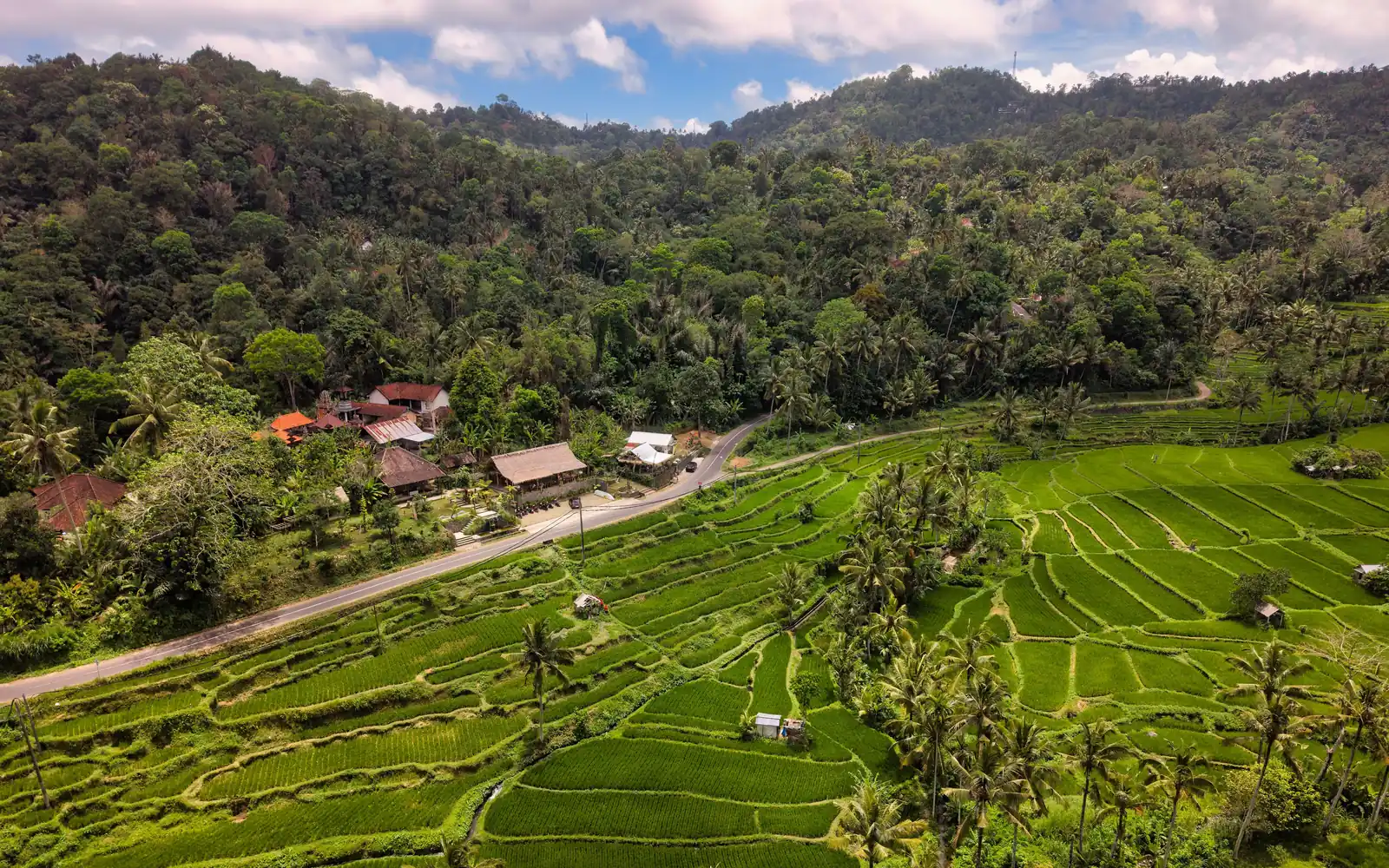
Photo: Tom Fisk / Pexels
Visa and entry
A Finnish passport is not on Indonesia’s visa-exemption list (regulation Perpres 95/2024; the list is mainly ASEAN countries and a few others). A Finnish citizen needs a visa. Source: Imigrasi Ngurah Rai, layanan WNA and the regulation list.
e-VOA, visa on arrival, index B1. Finnish citizens are covered by visa on arrival. The first stay is at most 30 days and can be extended once so that the total stay is at most 60 days. The fee is 500,000 rupiah. No sponsor is required. The passport must be valid for at least six months from arrival, and you need a return or onward ticket. The application is made before travel at evisa.imigrasi.go.id (alternative address in the guidance: indonesiavoa.vfsevisa.id); the electronic visa is usually sent within 24 hours. Validity is 90 days from issue, within which you must enter. An extension can be applied for online. A visa does not guarantee admission: the decision is made at the border. Source: Imigrasi, visa B1.
The same B1 can still be bought at the airport, but an e-VOA applied for in advance is usually smoother.
C1 visit visa (in practice replacing the older B211A class). The former B211A label does not appear in Indonesia’s official 2025 visa classification (Kepmen M.IP-08.GR.01.01 tahun 2025). The current single-entry visit visa for tourism, meetings and similar purposes is index C1: first stay at most 60 days, extensions can be applied for online up to a maximum of 180 days, fee 1,000,000 rupiah. A sponsor is not usually required (exceptions include certain nationalities and travel documents without a passport). The application needs, among other things, a passport (valid at least six months), a colour photo and proof of funds: a three-month bank statement of at least USD 2,000 or the equivalent. On a C1 you may not sell goods or services or receive wages or other compensation from a person or company in Indonesia. Source: Imigrasi, visa C1.
E33G, a limited-stay visa for remote workers (“digital nomad”). This limited-stay visa is for someone who lives in Indonesia and works for an employer registered abroad. The stay is one year, and the permit can be renewed online. A re-entry permit is included, so you can leave and return while the permit is valid. No sponsor is required. The fee for one year totals 7,000,000 rupiah (items: visa 500,000, category II confirmation 2,000,000, residence permit 3,000,000, re-entry permit 1,500,000). Special requirements: an employment contract with a company established outside Indonesia and a bank certificate of annual income of at least USD 60,000, plus a three-month bank statement of at least USD 2,000, a CV, an itinerary, a passport and a photo. Apply at evisa.imigrasi.go.id; processing is, according to the guidance, five working days after payment. The visa must be used within 90 days of issue. On the permit you may not do work that does not match the permit, or sell goods or services, except where that belongs to the work in question. Source: Imigrasi, visa E33G.
e-VOA (B1) and C1 are intended for tourism, visits and certain meetings — not for paid work in Indonesia. Remote work for a foreign employer is officially built around the E33G class. Do not assume that a “nomad life in Canggu on an e-VOA” meets the immigration rules.
The Ministry for Foreign Affairs (3 November 2026) requires the free ALL Indonesia declaration to be completed before travel. The correct form is free. Official address: allindonesia.imigrasi.go.id. In addition, travellers to Bali pay a tourist tax of 150,000 rupiah (from 14 February 2024). Source: Ministry for Foreign Affairs, Indonesia. On entry questions the Ministry refers people to the Indonesian embassy in Helsinki.
Vaccinations and health
According to the Ministry, tap water is not safe to drink, and illnesses from contaminated water or food are common. Dengue fever occurs widely in Indonesia, including in tourist areas; protect yourself against mosquitoes in the daytime as well. Jakarta is not, according to the Ministry, a malaria area, but the need for malaria prophylaxis depends on whether you travel outside Bali. Check current guidance in Terveyskirjasto’s traveller health guide and with your own healthcare provider, preferably one to two months before travel. Basic cover (tetanus and diphtheria, MMR) should be checked; hepatitis A vaccine is usually recommended for this kind of trip, but the decision is the doctor’s. Rabies occurs in Indonesia; be careful with stray animals and seek care immediately after a bite. Bali has had cases of methanol added to alcohol — be careful about the origin of drinks. Source: Ministry for Foreign Affairs, Indonesia. This does not replace a doctor’s assessment.
Money, cards and ATMs
The currency is the rupiah (IDR). Cards work in many tourist places, but cash is still needed. Tell your bank, take two cards from different schemes and decline dynamic currency conversion at the ATM unless you have a strong reason not to. Do not keep all cards and cash in the same place. Flights and stays: [AFFILIATE]. Card: [AFFILIATE].
Internet, Canggu, Ubud and eSIM
Canggu and Ubud are Bali’s best-known remote-work hubs: cafés, coworking spaces and rentals where the connection is usually good enough for video meetings. Speeds, outages and power or network problems in the rainy season vary from house to house — this page does not quote individual megabit figures. Ask the host about a reliable connection and a backup (for example an eSIM or local prepaid). An eSIM should be installed while still in Finland. eSIM: [AFFILIATE].
Plugs are typically type C or F (two round pins), mains voltage 230 V. Most modern chargers accept 100–240 V; you will still often need an adapter.
Insurance
The Ministry always recommends travel insurance and notes that evacuation is expensive and that some hospitals have refused to treat uninsured patients. Check that the policy covers Indonesia, any remote work, evacuation, scooter riding (if you ride) and a pre-existing condition. Ordinary short-holiday insurance is not always enough for a stay of several months. Travel insurance: [AFFILIATE]. Insurance for a longer stay: [AFFILIATE].
Safety
The Ministry’s level is “exercise a high degree of caution” (notice 3 November 2026). The possibility of terrorist acts exists; avoid large crowds. Natural disasters (earthquakes, volcanoes, floods and landslides in the rainy season) are common. Sea currents on the coasts of Bali and Lombok are strong and cause deaths every year, especially in the winter months.
Petty theft and threats with bladed weapons are, according to the Ministry, common in Bali and Lombok. Road safety is poor; wear a helmet and proper gear on a scooter. Narcotics laws are very strict. Make a travel notification. Source: Ministry for Foreign Affairs, Indonesia.
Etiquette
Temples are sacred: dress modestly, remove your shoes when asked, do not climb on shrines for a photograph and do not point with your feet. During ceremonies traffic may stop; give way. Outside tourist areas customs are often more conservative. In Bali, Hinduism is visible in daily life; in the rest of Indonesia Islam is the majority religion, and Aceh’s rules are especially strict (Ministry). Ask before photographing people at ceremonies.
Indicative costs
Numbeo user estimate (Denpasar, update 20 November 2026): monthly costs for one person excluding rent about USD 410. This is not official statistics. In Canggu and Ubud, rent, cafés and a scooter can lift the budget clearly above the Denpasar average, and the rainy season, festivals and the “nomad season” affect prices. On a short holiday the budget is driven more by flights and accommodation than by a monthly estimate.
Doctors, pharmacies and your own medicines
Seeing a doctor
According to the Ministry for Foreign Affairs (notice of 3 November 2026), hospitals in Indonesia are not at a European standard. In Jakarta and Bali, one of the better options is the international SOS Medika. Slow transport — especially in Canggu and in southern traffic — can delay access to care. Some hospitals have refused to treat uninsured patients, and evacuation by air is very expensive. In rural areas and northern Bali services are more limited than along the Denpasar–Canggu–Ubud axis. The European Health Insurance Card does not cover Indonesia.
Pharmacies
There are pharmacies (apotek) in tourist areas such as Canggu, Seminyak and Ubud. Quality varies, and the risk of counterfeits should be taken seriously. Buy only from a licensed pharmacy, not from street sellers or “health shops”, and keep the receipt. Do not leave medication for a chronic condition to local availability.
Bringing your own prescription medicines
According to the Ministry for Foreign Affairs, Indonesia has particularly strict narcotics laws: possession of even a small amount can lead to imprisonment, and in serious cases even the death penalty. Do not leave luggage unattended. Controlled medicines (including many psychotropic substances, such as benzodiazepines) are not “ordinary over-the-counter goods”, even if they are legal prescription medicines in Finland.
The exact milligram or day limits for personal import should be confirmed with Indonesia’s BPOM authority and the embassy in Helsinki before you travel. This page does not state a single figure such as “60 days” without an opened, unambiguous official traveller guide — this point must be checked. Take a prescription, a doctor’s statement in English (active substances, dose, the need for the diagnosis), original packaging, and carry the medicines in hand luggage. Clonazepam, clobazam, other benzodiazepines and phenobarbital should be treated as controlled substances until the embassy confirms otherwise. The Schengen certificate is not valid in Indonesia. Importing narcotics without the appropriate permit is prohibited.
General tips if you travel with prescription medicines
- Keep medicines in their original packaging and carry them in your hand luggage, not in checked baggage.
- Take a little extra in case a flight is delayed or a pack goes missing — but do not exceed the amount the destination country allows.
- How the time zone affects dosing should be agreed with your treating doctor in advance. This page does not give dosing advice.
- Check that your travel insurance covers a sudden worsening of a pre-existing condition and evacuation. Terms from Finnish insurers vary; declare the condition honestly and ask for written confirmation if needed. The Ministry for Foreign Affairs always recommends checking the cover, especially if you have an illness.
- Kela usually reimburses medicines from a pharmacy for a maximum of three months at a time (for an expensive medicine, a maximum of one month). This applies to people resident in Finland. Source: Kela, Medicines and travel.
- A Finnish electronic prescription works only in certain EU countries, not in Asia. For Asia you usually need paper documents (a prescription or a doctor’s statement, preferably in English). Source: Kanta.fi (page updated 6 March 2026) and EU-terveydenhoito.fi.
- The Schengen certificate available from a pharmacy applies only to the Schengen area and to at most 30 days of medication. It is not valid in these Asian countries. Source: Fimea, Schengen certificate.
Example: more than one epilepsy medicine
If you take several medicines long term — for example three epilepsy medicines — establish the active substance of each product separately. Some epilepsy medicines, such as benzodiazepines (for example clonazepam and clobazam) and phenobarbital, are classified as controlled substances in many countries. A Finnish prescription is then not always enough: you may need advance permission, strict quantity limits, a customs declaration or a doctor’s certificate in English. Do not change or stop your medication on your own; agree a plan with your doctor and check the list with the destination country’s authorities.
Sources: Ministry for Foreign Affairs, Indonesia (3 November 2026), International SOS Medika, mentioned by the Ministry, Indonesia’s BPOM and the embassy (exact import quantity limits must be checked; they are not stated here without an open official traveller guide), Kela, Fimea, Kanta.fi.
Weather month by month
In Bali the drier season is typically about April–September (driest in July–August) and the rainy season October–March, at its most intense in December–February. The Ministry for Foreign Affairs describes Indonesia’s rainy season generally as October–April, peaking in January–February. The Ubud highlands are often a little cooler and more humid than the south coast (Canggu, Seminyak, Kuta); the table below describes southern Bali at the Denpasar / Ngurah Rai station.
The rainfall classification is the site’s own, based on monthly rainfall, so the tables can be compared. The figures are long-term averages (not a forecast for a single year). Information checked on 22 November 2026.
Southern Bali (Denpasar / Ngurah Rai)
| Month | Mean daily maximum | Rainfall | Note |
|---|---|---|---|
| Jan | 30.9 °C | Heavy350.7 mm | Peak of the rainy season |
| Feb | 30.9 °C | Heavy289.8 mm | Peak of the rainy season |
| Mar | 31 °C | Heavy231.1 mm | — |
| Apr | 31 °C | Moderate107.4 mm | — |
| May | 30.5 °C | Moderate94.7 mm | — |
| Jun | 29.8 °C | Light67.9 mm | — |
| Jul | 29 °C | Light27.6 mm | Driest month |
| Aug | 29.1 °C | Light36.4 mm | Dry season |
| Sep | 30 °C | Light59.4 mm | — |
| Oct | 31 °C | Light64.4 mm | — |
| Nov | 31.6 °C | Moderate131.2 mm | — |
| Dec | 30.8 °C | Heavy327.4 mm | Rainy season |
Best months for general travel (marked with a gold line in the table): May, Jun, Jul, Aug, Sep. “Best” usually means drier, more comfortable weather; diving, hiking or winter sports may favour other months.
Source: Rainfall: JMA ClimatView, Denpasar/Ngurah Rai station (97230), Normal column for monthly rainfall (checked 22 November 2026). Mean daily maximum: Wikipedia climate table for Denpasar (Ngurah Rai, 1991–2020; see Wikipedia, Denpasar); the source listed on the table is secondary, but the values (about 29–32 °C) are in line with JMA observations at the same station.